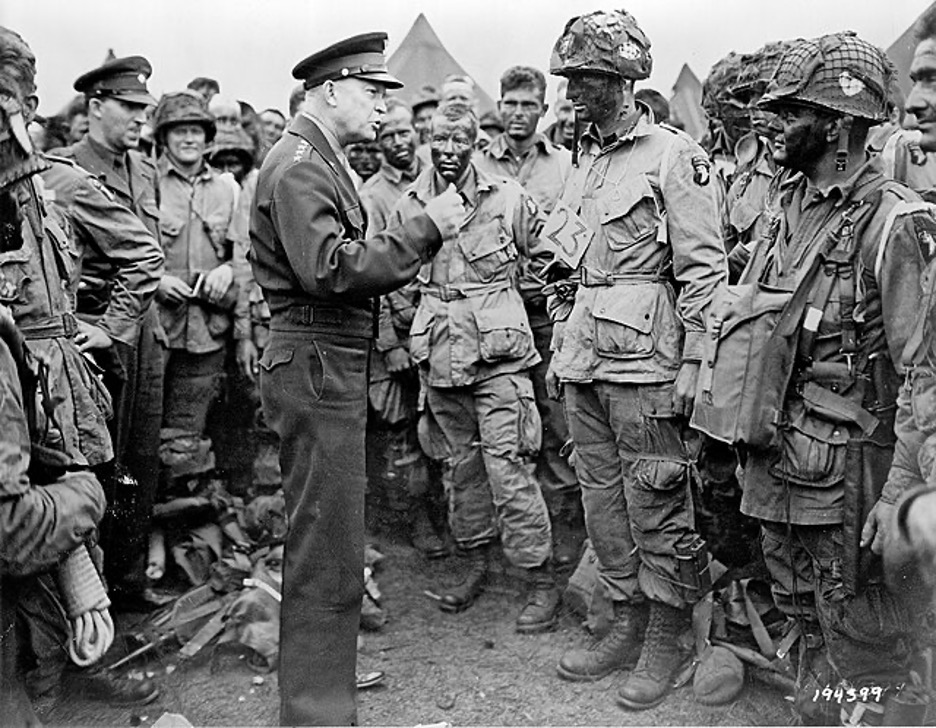
D-Day, June 6, 1944, was one of the defining moments of the twentieth century for the United States and the Western world. The fate of the European continent hung in the balance as the largest amphibious assault force in history landed over 150,000 troops on the fiercely defended beaches of northern France.
The success of Operation Overlord is well documented and often celebrated as a decisive American triumph. The books, movies, and “Back-to-Back World War Champs” T-shirts seen on the Fourth of July can lead some to believe the Allies’ success was inevitable, but that was far from the case.
Tidal requirements for landing craft and moon illumination for supporting airborne operations restricted the invasion to a narrow window, from June 5 to 7. Initially, the invasion was set to occur on June 5, but was postponed by one day due to deteriorating weather conditions. The hope was that a brief improvement forecast for June 6 would hold. If it did not, the operation would have to be pushed back by weeks, putting the mission’s secrecy at risk.
Earlier amphibious operations highlighted just how risky an assault on Germany’s Atlantic Wall could be. For instance, the 1942 assault on the port of Dieppe resulted in well over half of the 6,000-man force being killed, wounded, or captured. That failure framed the Allied understanding of what could go wrong at Normandy.
Weather, enemy action, or any number of unforeseen events could have easily prevented the Allied forces from securing a foothold in northern France, putting the entire war effort at risk. For the 2.8 million troops assembled in Britain, and for General Dwight Eisenhower, the commander of the invading force, success was anything but assured.
Eisenhower’s “In Case of Failure” Note
One of the most important preparations Eisenhower made before the invasion had nothing to do with mission success. He drafted a handwritten statement for public release, accepting full responsibility for the operation in the event of its failure:
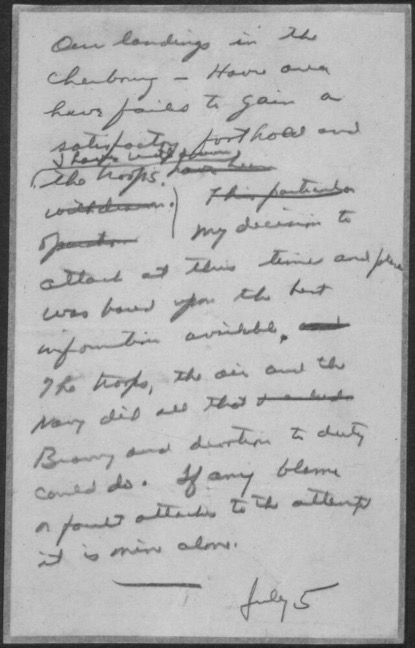
“Our landings in the Cherbourg-Havre area have failed to gain a satisfactory foothold and I have withdrawn the troops. My decision to attack at this time and place was based upon the best information available. The troops, the air, and the Navy did all that bravery and devotion to duty could do. If any blame or fault attaches to the attempt, it is mine alone.”
Eisenhower was ready to take personal responsibility for the outcome of the operation, even though he could not reasonably predict or directly control many of the factors influencing its result. He relied on the judgment of numerous advisors and staff, thousands of subordinate leaders, and millions of men and women to execute their share of the task, many in direct contact with a formidable enemy force.
A Commitment to Responsibility
Today, this commitment to owning the outcome is rare. We often see leaders shift the responsibility for failure to subordinates, unforeseen circumstances, or competitors whom they accuse of undermining their efforts. When responsibility is acknowledged, it is often reduced to a weak apology offered only after intense public scrutiny.
What many people do not understand is that shirking responsibility projects a fundamental weakness in their leadership. It signals that they have lost control or that another factor was able to derail their efforts. These leaders risk appearing easily defeated. Owning failure, when done honestly, reinforces authority rather than undermining it. People are surprisingly forgiving of failures and respond well to accountability, especially when the effort is genuine and the circumstances difficult.
Had the Germans won the day on June 6, we might be much more familiar with Eisenhower’s “In Case of Failure” note. He would have certainly faced serious professional consequences, but dodging responsibility for the outcome would have exposed him as lacking control over his organization. Instead, he made the choice to remain stoic and responsible even if the operation failed, preserving himself and inspiring those around him to do the same.
Deflecting blame may appear to be personally advantageous in the moment, but in the long run it hurts both the leader and the organization. It is important to expect accountability not only from ourselves but from those whom we elevate to leadership positions.
 Doug's Desk
Leave a comment